
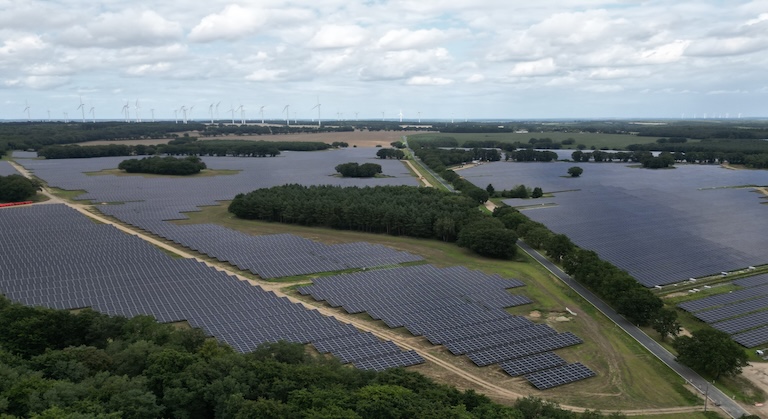
- Attractive interest, low electricity generation costs
- Biodiversity-oriented, including 10 km of hedgerows
- Community electricity tariff and high municipal revenues
Welcome note
Dear Sir or Madam, dear citizens,
Together, with support under the Renewable Energy Sources Act (EEG), we have achieved that solar power has become a key pillar of Germany’s energy supply. Today we can generate it on such a large scale that we can supply not only private households but also German industry directly. This great success can now increasingly be turned into affordable and sustainable electricity for the country and its people.
While we in Germany suffer from comparatively high energy costs, solar power from large solar parks can now reduce electricity costs for regions and municipalities. In addition, we have battery storage systems that are already integrated or can be retrofitted – and are subsidy-free! – which make it possible to deliver solar power “at the push of a button or at night”.
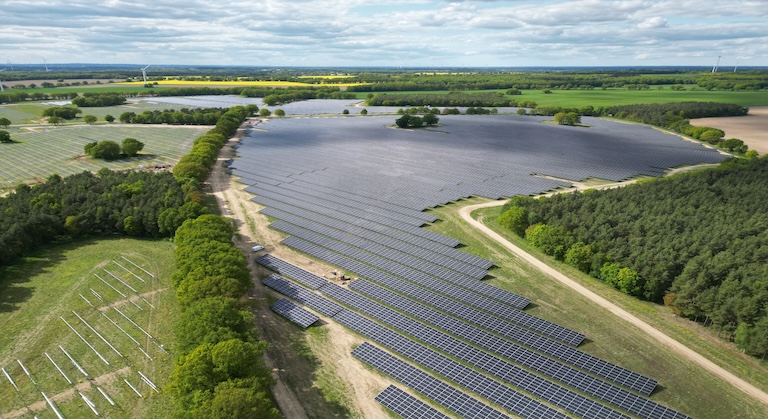
Solar parks can also promote biodiversity. For our project, we have deliberately developed an approach that promotes biodiversity – including a 10-kilometre-long, three-row hedge instead of a permanent mesh fence. Our site is thus the largest German project to date with a consistently biodiversity-oriented design.
Besides nature, local people also enjoy numerous benefits. Even before the project was approved, we – in an action that was unique until now – created, together with the citizens, 20 solar roofs and 200 kWp in a self-build campaign that we supported. After the site is commissioned, we will make a community electricity tariff from the solar park available to all residents, which will massively reduce local electricity costs.
The municipality of Halenbeck-Rohlsdorf will also benefit from commissioning onwards, with secure annual revenues from the municipal levy in the mid six-figure range. After the initial years, trade tax from the locally based project companies will also flow in.
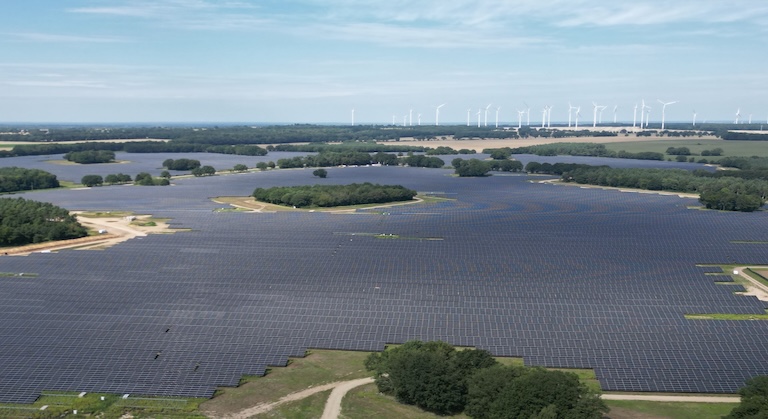
Our Sonnenpark Halenbeck-Rohlsdorf project is already well advanced in construction and consists of two roughly identical sub-projects, each with approx. 115 MWp of capacity. This solar park draws on our experience from more than 33 years of business activity in the solar sector.
And our solar park increasingly delivers “sun at night”. In addition to the basic equipment of the solar park with batteries for its own consumption and the community electricity tariff, the design of the site already provides for further equipment with battery storage. This can be done in individual steps at very low cost, which makes the entire site even more future-proof.
Of course, besides the environment, the Sonnenpark Halenbeck-Rohlsdorf also protects the climate. The site reduces harmful emissions from fossil energy generation. In total, once completed, the project saves around 100,000 tonnes of CO2 per year. With this solar park, too, we demonstrate that economy and ecology can go hand in hand very well.
As mentioned, the project is already well advanced in construction and thus offers you a financially, ecologically and socially sustainable investment. In addition to attractive interest, you can rely on a well-thought-out and economically well-secured investment asset.
We would be delighted to welcome you as an investor!
Contribution to the UN Sustainable Development Goals
Fossil energy supply poisons the air we breathe with a toxic mix of, among others, sulphur dioxide, nitrogen oxides, carbon monoxide, mercury and arsenic. The methane and CO2 emissions of fossil energy sources intensify global warming. Solar energy generation avoids the emissions that are harmful to people, nature and the climate.
Subsidy-free solar power generated in Germany makes energy affordable while protecting the environment and the climate.
Fair wages and working conditions already during construction.
Supply of the region with renewable electricity
Creation of permanent, well-paid local jobs for the operation, maintenance and further development of the solar installations.
Regional value creation for the local economy and municipality.
The solar power from the Halenbeck project is delivered in the form of a power purchase agreement (“PPA” for short) for climate-friendly industrial processes in Germany. This reliable and future-proof energy supply strengthens industry and avoids the risks and dependencies of fossil energy supply.
The community electricity tariff on offer brings considerable savings for all income groups – and thus significant relief, in particular for lower-income households, which are especially hard hit by high energy costs.
Through the municipal levy and trade tax, the municipality receives high revenues that are permanently predictable and can thus better fulfil all municipal tasks. With the solar roof project, which began in 2023, solar installations were realised on more than 20 properties through supported, low-cost self-build, which massively strengthens the infrastructure. Electricity on site for the people on site is delivered through the community electricity tariff.
Preserving and expanding biodiversity are the priority here alongside solar power generation. The entire planning is designed for this – including a roughly 10 km long perimeter hedge, wide row spacing and other measures.
The Sonnenpark Halenbeck is the largest German site that is fully designed to strengthen biodiversity. We ensure that plants, insects and animals can resettle or settle for the first time. The areas are mown less often and thus offer better conditions for the settlement of plants and insects than conventionally managed soil. Because different flowering plants can establish themselves, staggered flowering sequences emerge over time. Insects benefit from this, as they find different food sources throughout the year. The resulting abundance of insects in turn contributes to the settlement of breeding bird species, for which insects are an important food source. The surrounding agriculture and landscape also benefit from the increase in biodiversity on the area of the solar park. You can find a detailed description at: www.sonne-sammeln.de
The exploitation of raw materials such as oil, gas or uranium repeatedly leads to geopolitical tensions and even armed conflicts – usually with severe consequences, particularly for civilian populations. Reducing or replacing the use of fossil raw materials is an important contribution to a more peaceful, safer and fairer world.
Opportunities and risks
| Opportunities | Risks |
|---|---|
|
|
Construction and permanent operation of a next-generation solar power plant, (largely) free of subsidies, with a planned capacity of up to 115 megawatts of nominal output.
The project offered here is part of the overall Sonnenpark Halenbeck-Rohlsdorf project, which consists of two almost identical projects with a maximum of 115 megawatts of nominal output each. The "sister project" at the same site, which is also already well advanced in construction, has secured equity from "DAL Deutsche Anlagen-Leasing", a specialist in arranging and structuring large-volume and asset-based financing projects, as a 50 per cent shareholder. You can find further information on this here.
The next generation of solar power plants is characterised by integrated storage and targeted optimisation of biodiversity. The project is being built on soils that are now difficult to use for intensive agriculture, so-called "disadvantaged areas".
In order to be able to offer the solar power generated on the market as far as possible without subsidies, the aim is to keep the costs of building and operating the plant to a minimum. The project has achieved this through the sheer size of the plant and a very high level of in-house value creation in the development, construction and operation of the plant.
Only underground cables are used for the grid connection. In addition, several fast-charging points for electric cars are being provided, primarily for use by the local population.
For maintenance and operational management, a property no longer used for agriculture has been taken over and renovated. Given the planned scale, the aim is to create 5 jobs for maintenance and upkeep on site.
Project status
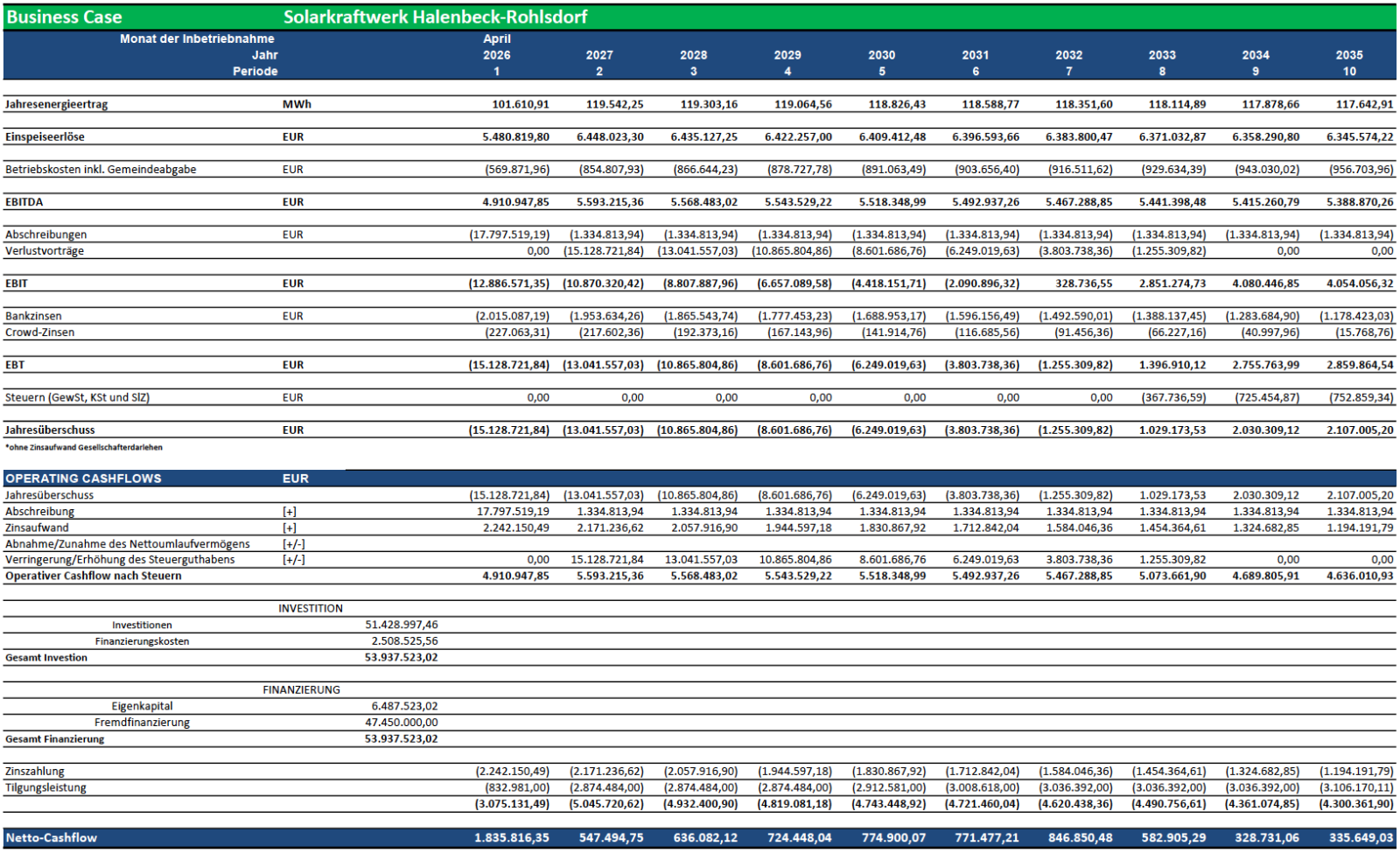
The project has obtained all permits and is fully financed. A total of 93% of the electricity has been sold on a long-term basis or is financially secured for 20 years through an EEG award (EEG-Zuschlag).
Construction is well advanced. All of the roughly 200,000 solar modules have already been installed and cabled. The plant is expected to be connected to the 110 kV network of e.dis's distribution grid at the end of the first quarter or the beginning of the second quarter of 2026.
Electricity sales
75% of the electricity from the plant has been sold to a creditworthy, energy-intensive industrial customer under a fixed 10-year power purchase agreement ("PPA" for short). For around 17% of the installed capacity there is also an EEG award for 20 years. This electricity is also sold directly to commercial customers.
Equity and use of proceeds from the crowdfunding
The equity of approx. 6.5 million euros has so far been contributed by the shareholders' funds and has been paid in in full. The funds raised through the crowdfunding are to be used for new solar and storage projects.
Industry-leading benefits for the municipality and its residents
Very low-cost electricity tariff for all households: As soon as the plant goes into operation, expected in the 3rd quarter of 2026, we will offer an electricity tariff to all residents of the municipality of Halenbeck-Rohlsdorf. It will be particularly low-cost because it uses electricity from the solar plant and, at night, from the storage systems.
Infrastructure
A fast-charging infrastructure and a long cycle path between parts of the municipality will be built. Existing properties that would otherwise stand empty will be secured for the long term and used by the Sonnenpark as workshops.
Financial investment opportunities
With preferential conditions on the DKB-Bürgersparen and on this crowd financing.
Solar rooftop project
"Let's fill the roofs!" was one of the suggestions from the various information events on the planning of the Sonnenpark. By using bulk purchasing and close cooperation, we are bringing solar systems of good quality and at low cost to all the roofs of Halenbeck-Rohlsdorf. This initiative is already a great success. So far, 20 roofs with a capacity of approx. 200 kWp have been completed.
Substantial financial leeway through the "municipal levy" and "trade tax"
From the municipal levy, approx. 230,000 euros per year flow to the municipality, or to the voluntary services to be decided upon from it, from the part of the plant described here. For the overall project, the figure is approx. 460,000 euros.
We have our registered office in Halenbeck-Rohlsdorf and pay trade tax locally. Even after deducting the required state and municipal charges, additional funds are thus available to the municipality every year.
Securing the energy supply
With the Sonnenpark, you, the people of Halenbeck-Rohlsdorf and our whole country gain a significant degree of energy supply security – almost entirely without subsidies. This is because significantly fewer fossil fuels need to be imported. The electricity storage systems integrated into the Sonnenpark additionally ensure a reliable energy supply.
Last but not least – massive benefits for the environment and health
The Sonnenpark's land will be managed permanently without the use of pesticides, herbicides and fertiliser. This will massively increase biodiversity on the site. Many more insects, birds and many other living creatures will settle there. This will be published in annual species surveys on our website.
Approx. 10 km of three-row hedges will create a new, large habitat that at the same time provides a visual screen, moisture retention and protection against soil erosion.
You can find out more about the positive effects on biodiversity in solar parks here: https://sonne-sammeln.de
In addition to the considerable benefits for the local environment, by largely avoiding the burning of fossil fuels the Sonnenpark leads to a massive reduction in air pollutants such as mercury, sulphur oxides, nitrogen oxides, carbon monoxide, particulate matter, lead, arsenic, etc., as well as to a permanent avoidance of almost 100,000 tonnes of CO2 per year by replacing coal-fired power generation.
Foreseeable expansion and use of infrastructure
Retrofitting storage systems in the park and at the substation offers sensible development opportunities.
On the areas of the solar park that are reserved for storage and technically prepared for it, storage capacity – and with it electricity marketing capabilities – can be expanded in stages.
At the solar park's own substation, capacity is available for a hybridisation of the substation with storage, wind energy or other forms of generation, and possibly also consumers such as data centres, in order to make better permanent use of the infrastructure.
These options can be implemented by the project company itself or with partners.
Use of proceeds
The capital raised through this offer is used to redeem up to 70% of the equity of approx. 6.5 million euros already paid into the solar park project company. The capital is thus used exclusively to finance the Solarkraftwerk Halenbeck-Rohlsdorf project, which is already well advanced in construction, within the financing structure described.
Project company
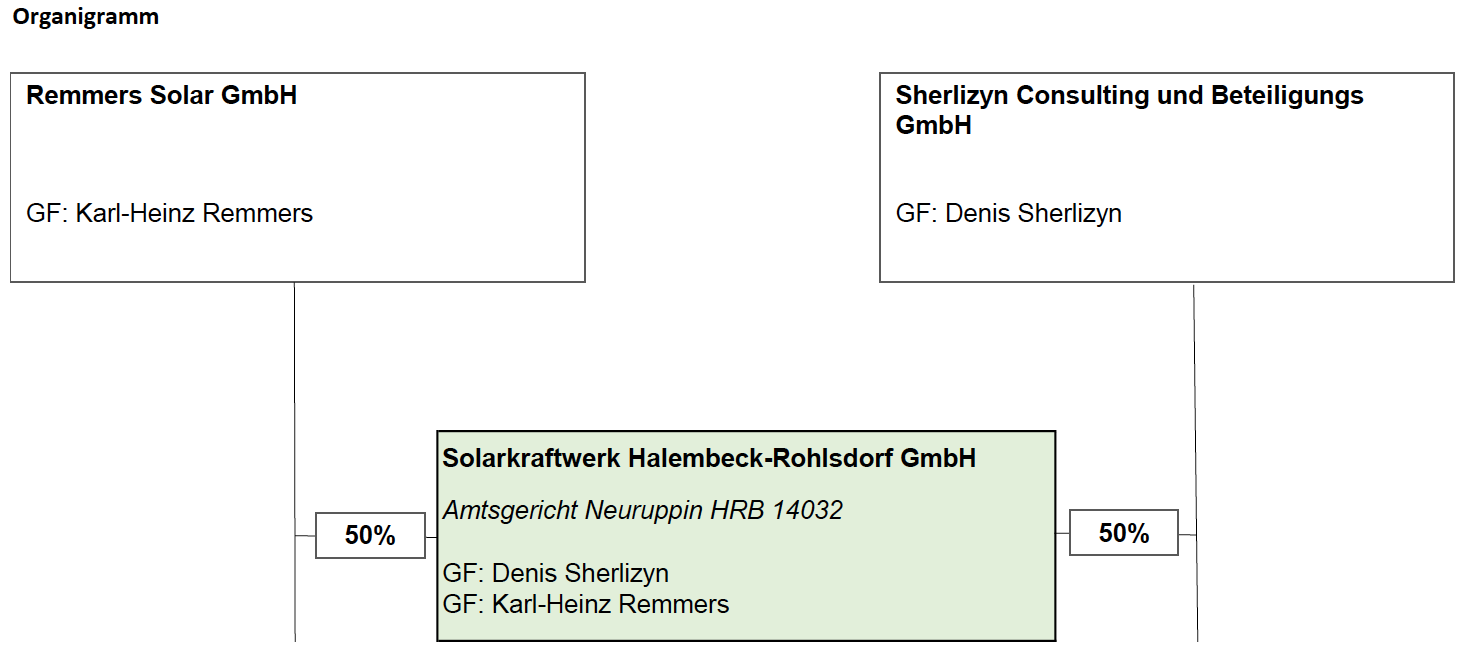
The Sonnenpark Halenbeck-Rohlsdorf is a project of Solarkraftwerk Halenbeck-Rohlsdorf GmbH.
One founder and managing director is Karl-Heinz Remmers, a graduate engineer in energy technology (TU Berlin).
In 1992, Karl-Heinz Remmers founded his first company for the construction of solar systems in Oranienburg. Under the brand name Solarpraxis, he has contributed to the planning and realisation of solar systems with a capacity of over 4 gigawatts worldwide, has also written specialist books and helped to establish a specialist publishing house for solar energy.
Since 1999, Karl-Heinz Remmers has been involved in various professional associations to promote a sensibly designed energy transition.
Since 2009, he has been operating several dozen solar parks and solar systems in Germany with medium-sized partners. These include the companies pv project Deutschland, Solarpraxis Engineering and ASG Solar. Karl-Heinz Remmers is responsible for the management of Solarkraftwerk Halenbeck-Rohlsdorf GmbH together with his partner Denis Sherlizyn.
Denis Sherlizyn is the second founder and also a managing director. As a businessman, he has been overseeing dozens of large solar systems in development, construction and operation together with other partners since 2010.
Organisation chart
Residents with a primary or secondary residence in Halenbeck, Brügge, Warnsdorf, Rohlsdorf and Ellershagen have the opportunity, through so-called "crowdinvesting", to invest money in the Sonnenpark Halenbeck-Rohlsdorf being built in their municipality.
It is possible to subscribe to a fixed-interest loan. The interest rate is 6 per cent per year with a term of 10 years. There are no closing fees for investors.
After the first subscription phase has ended, the group of eligible subscribers will be opened up:
Residents of the Federal Republic of Germany can then subscribe to a deposit at an interest rate of 5 per cent per year.
The total investment is limited to 25,000 euros for natural persons. Investments are possible from 250 euros up to 25,000 euros in steps of 50 euros. Liability is limited to the amount invested. Annual repayment in equal instalments over a term of 10 years. Payments fall due on 31 December in each case.
| Term | Interest | Repayment | Interest date | Maturity |
|---|---|---|---|---|
| 10 years | 6.00 % p. a. | Instalment loan | 31 December annually (first on 31 December 2025) | 31.12.2035 |
| Type of loan | Instalment loan |
|---|---|
| Interest payment frequency | annually |
| Available from | 15.10.2025 |
Downloads
Your personal payment plan (6.00 % interest p. a.)
| Year | Date | Payment (gross) | Interest | Repayment | Status |
|---|
Example calculation based on the terms, without accrued interest or a different first interest period; amounts rounded. Only the loan agreement and the investment information sheet (Vermögensanlagen-Informationsblatt) are authoritative. Taxes are not taken into account.